Choosing the best stair climber with handrails depends on whether you need rehabilitation support, everyday mobility assistance, or a more demanding home cardio workout. The products in this roundup cover those distinct use cases, from adjustable therapy stairs to compact vertical climbers and stepper machines.
Use the buying guide below to compare stability, resistance, adjustability, footprint, and user support before choosing the model that fits your space and goals.
Best 10 Stair Climber with Handrails Picks for 2026
Best Rehabilitation Step
Adjustable Handrail Therapy Stairs

- 660-lb capacity stainless steel frame
- Adjustable handrails for supported exercises
- Slip-resistant surface for secure footing
Best For: Home and professional rehabilitation
Best Commercial Cardio Climber
Smart Stair Climber with Handrails
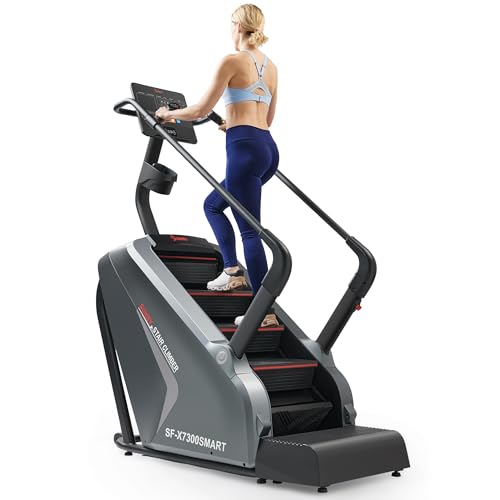
- 25 EMS levels and 36 preset workouts
- Full-length handrails with auto-stop sensors
- 400-lb capacity and SunnyFit app support
Best For: High-intensity home or commercial cardio training
Best Stair Assistance Aid
Adjustable Climbing Assist Cane

- 20 height settings from 35 to 45 inches
- Four non-slip feet and ergonomic grip
- Lightweight 4.5-lb carbon steel design
Best For: Supported household stair navigation with a fixed handrail
Best Compact Home Workout
Adjustable-Handle Vertical Climber

- Full-body climbing motion for home workouts
- Three adjustable resistance springs
- Adjustable handlebars and pedals with 330-lb capacity
Best For: Compact full-body home exercise
Commercial-Grade Pick
90% Pre-Assembled Stair Master

- 15 speed levels from 30–164 steps per minute
- Multi-grip handrails with controls and emergency stop
- 375-lb capacity with eight preset programs
Best For: Dedicated home gyms and frequent cardio training
Space-Saving Choice

- Foldable frame for home storage
- Adjustable resistance and three angles
- 300-lb capacity with LCD tracking
Best For: Small home gyms and flexible everyday workouts
Adjustable-Height Pick

- Three adjustable handlebar heights
- Three resistance levels and two incline modes
- Folds flat with quiet operation and LCD tracking
Best For: Shared home use and compact storage
Best Stable Frame Pick
OWLSKY Full-Body Stair Stepper

- Triangular steel frame supports up to 300 pounds
- Adjustable resistance, pedals, and detachable armrests
- LCD monitor and device holder for guided workouts
Best For: Stable full-body home workouts
Best Foldable Option
Adjustable Resistance Stair Climber

- Three angles and adjustable resistance customize training
- Shock-absorbing springs support quiet, smooth motion
- Folds flat and supports up to 300 pounds
Best For: Quiet workouts in compact homes
Best Resistance Range
HXD-ERGO Six-Level Stair Stepper

- Six resistance levels offer broad workout control
- Three-position adjustable handlebar supports varied users
- Quiet, low-impact motion with a 300-pound capacity
Best For: Customizable, supported home training
Best Rehabilitation Step – Adjustable Handrail Therapy Stairs
If you need a stair climber with handrails for rehabilitation rather than cardio training, this therapy step emphasizes stability, support, and secure footing. Its stainless steel construction supports up to 660 pounds, while adjustable handrails help users practice steps, lunges, and balance exercises with added confidence.
Best For: Home, clinic, or gym rehabilitation exercises focused on mobility, coordination, balance, and leg strength.
Pros:
- 660-pound maximum weight capacity with durable stainless steel construction
- Adjustable handrails provide support during stepping and balance exercises
- Textured, slip-resistant surface helps promote secure footing
- Compact design suits many home and professional spaces
Cons:
- Designed as a single-level therapy step rather than a powered cardio stair climber
- At 90 pounds, it is not especially lightweight to reposition
This is a practical choice when controlled rehabilitation and fall-risk reduction matter more than workout programming. Consider it for therapeutic stepping, not automated stair-climbing exercise.
Best Commercial Cardio Climber – Smart Stair Climber with Handrails
For shoppers seeking a stair climber with handrails for serious cardio training, the Sunny Health & Fitness SF-X7300 combines full-length handrails with commercial-grade construction and programmed workouts. Its 25 EMS resistance levels, four-step design, and 400-pound capacity make it suited to demanding indoor sessions.
Best For: Users who want high-intensity, low-impact stair workouts with workout tracking, preset programs, and app connectivity.
Pros:
- 25 EMS speed levels and 36 pre-programmed workouts support varied training
- Full-length handrails, infrared auto-stop sensors, and docking step add safety features
- Tracks time, steps, height, calories, levels, pulse, and steps per minute
- Supports up to 400 pounds and includes SunnyFit app compatibility
Cons:
- Large, heavy footprint at 69.3 by 31.3 by 84 inches and 407.9 pounds
- Its commercial-grade feature set may be more than casual users need
This is the most complete fitness-oriented option in the group, especially for users who value structured training and detailed metrics. Plan carefully for delivery and placement because of its substantial size and weight.
Best Stair Assistance Aid – Adjustable Climbing Assist Cane
This stair climber with handrails is an assistive cane rather than an exercise machine. It is intended to be used alongside a fixed household stair handrail, with 20 height settings, an anti-slip handle, and four stabilizing feet to provide added support on standard indoor stairs.
Best For: Adults who need a lightweight, portable aid for navigating household stairs while also using a fixed wall-mounted handrail.
Pros:
- 20 height adjustments from 35 to 45 inches accommodate different steps
- Four non-slip rubber feet are designed for wood, tile, and stone stairs
- Carbon steel construction weighs about 4.5 pounds for easier portability
- Slim profile can stand near stairs without blocking pathways
Cons:
- Must be used with a fixed household stair handrail
- Should not bear the user’s full body weight
- Provides stair assistance, not powered lifting or exercise training
This cane can be useful when portability and adjustable positioning are priorities, but its safety instructions are essential. It should supplement—not replace—a secure household handrail.
Best Compact Home Workout – Adjustable-Handle Vertical Climber
If you want a stair climber with handrails for full-body home workouts, the OWLSKY vertical climber uses a triangular steel frame, adjustable resistance springs, and height-adjustable handlebars. It simulates climbing while engaging the core, arms, legs, glutes, and back, with an LCD monitor for basic workout tracking.
Best For: Home users seeking a compact, quiet-feeling vertical climbing workout with adjustable resistance and handlebars.
Pros:
- Full-body climbing motion targets the core, arms, legs, glutes, and back
- Three resistance springs allow training intensity to be adjusted
- Three-level adjustable handlebars and pedals support fit customization
- 330-pound capacity with a stable triangular steel frame
Cons:
- Offers three resistance springs rather than the broader programmed settings of a commercial climber
- LCD monitor provides basic metrics rather than advanced connected tracking
- Its 50.79-inch height still requires suitable overhead and floor space
This model offers a simpler home-training alternative to a large commercial stair machine. It is a good fit for users who want adjustable handrail height, resistance, and full-body movement without the heavier feature set.
Commercial-Grade Pick – 90% Pre-Assembled Stair Master
If you want a stair climber with handrails for serious cardio and lower-body conditioning, this commercial-style model offers 15 speed levels, multi-grip handrails, and a sturdy reinforced frame. Its 375-pound capacity and large footprint make it better suited to a dedicated home gym than a compact workout corner.
Best For: Users seeking a durable, full-size stair climber for progressive cardio, glute, leg, and core training.
Pros:
- 15 adjustable speeds from 30 to 164 steps per minute accommodate different fitness levels.
- Multi-grip handrails include integrated speed controls and an emergency stop button.
- LED display tracks heart rate, calories, time, and steps, with eight preset programs.
- Low-impact climbing is designed to support cardio and lower-body conditioning.
Cons:
- At 408 pounds, it is difficult to move once installed.
- The 56-by-33-by-83-inch size requires careful doorway and ceiling clearance checks.
- Its 375-pound user capacity is lower than the machine’s own weight.
This is the most substantial option in the group, with the controls, programs, and stability expected for frequent training. Confirm the available space before buying, since its commercial-style construction prioritizes sturdiness over portability.
Space-Saving Choice – MERACH Foldable Stair Stepper
For shoppers comparing a stair climber with handrails for a smaller home gym, the MERACH Stair Stepper emphasizes adjustability and storage. It combines adjustable resistance, three adjustable angles, secure handlebars, and a foldable frame in a considerably lighter package.
Best For: Home users who want a foldable, lower-weight stair stepper with adjustable workout settings.
Pros:
- Foldable design measures 33.9 by 22.1 by 47.2 inches and weighs 26.5 pounds.
- Adjustable resistance and foot pedals let users tailor workout intensity.
- LCD monitor tracks time, steps, and calories burned.
- Non-slip pedals, secure handlebars, and a 300-pound capacity support stable workouts.
Cons:
- Its 300-pound capacity is lower than the larger commercial-style model.
- The notes do not specify the exact resistance range.
- Storage still requires room for its folded frame.
The MERACH is a practical middle ground for home use: more compact and portable than a full-size stair master while offering useful resistance adjustments and progress tracking. It is a strong fit when storage convenience matters as much as workout versatility.
Adjustable-Height Pick – HXD-ERGO Home Stair Stepper
The HXD-ERGO is a stair climber with handrails designed around height flexibility and compact storage. Its handlebars offer three height settings, while two incline modes and three resistance levels provide simple ways to change the challenge at home.
Best For: Households wanting a compact, quiet stepper with adjustable handlebars and basic workout customization.
Pros:
- Handlebars adjust to 48.81, 50.78, or 52.75 inches for different users.
- Three resistance levels and six springs support gradual workout progression.
- Two incline modes allow a more varied climbing motion and glute emphasis.
- Folds flat, operates quietly, and includes an LCD for steps, time, and calories.
Cons:
- The supplied details list a 300-pound capacity, despite one feature description mentioning 500 pounds.
- It offers only three resistance levels and two incline modes.
- Its 18.3-by-17-inch footprint may provide less stepping space than a full-size stair machine.
The HXD-ERGO stands out for shared household use because its adjustable handlebars accommodate different heights. Buyers should verify the weight-capacity specification with the seller before purchase, then take advantage of its folding frame for easier storage.
Best Stable Frame Pick – OWLSKY Full-Body Stair Stepper
If you want a stair climber with handrails for full-body home workouts, the OWLSKY combines a triangular steel frame with detachable Flybar armrests and adjustable anti-slip pedals. Its resistance springs and 300-pound capacity make it a practical option for users who want added stability while training.
Best For: Home users seeking a stable, adjustable stair climber for combined cardio and muscle-toning workouts.
Pros:
- Engages the core, arms, legs, glutes, and back in one climbing motion.
- Three resistance springs allow workout intensity to be adjusted.
- Three-level adjustable anti-slip pedals and detachable armrests support a more comfortable fit.
- LCD monitor tracks time, calories, reps, and total reps, while the device holder supports phone or tablet use.
Cons:
- The armrests are detachable rather than described as permanently fixed.
- The supplied notes do not specify a folded storage size.
With its reinforced triangular frame, adjustable contact points, and built-in workout tracking, the OWLSKY is a well-rounded choice when stability and full-body training matter more than advanced storage features.
Best Foldable Option – Adjustable Resistance Stair Climber
This stair climber with handrails is designed for homes where quiet operation and easy storage are priorities. It offers adjustable resistance, three climbing angles, shock-absorbing springs, and a foldable steel frame rated to support up to 300 pounds.
Best For: Apartment dwellers and home users who want a quiet, foldable climber with supportive foam-grip handles.
Pros:
- Three adjustable angles and variable resistance support different workout intensities.
- Shock-absorbing, noise-reducing springs are designed for a smoother, quieter stride.
- Extended foam grip handles provide added stability and comfort during climbs.
- Folds flat for storage under beds or in closets and supports up to 300 pounds.
Cons:
- The supplied notes do not describe handlebar height adjustment.
- Its 35.24-inch length may still require dedicated floor space during use.
The combination of folding storage, low-noise springs, and multiple adjustment options makes this a strong fit for compact living spaces and users who prefer measurable, customizable cardio sessions.
Best Resistance Range – HXD-ERGO Six-Level Stair Stepper
For shoppers comparing a stair climber with handrails, the HXD-ERGO stands out with six resistance levels and a three-position adjustable handlebar. Its triangular metal frame, smooth motion, and low-impact design make it suitable for users who want to vary intensity while maintaining a supported posture.
Best For: Beginners and experienced users who want broad resistance adjustment and height-adjustable handrails.
Pros:
- Six resistance levels provide more intensity choices than a basic stepper.
- Three handlebar height settings help accommodate different users and postures.
- Quiet, smooth motion is designed for home use and low-impact training.
- Corrosion-resistant triangular steel construction supports up to 300 pounds.
Cons:
- The supplied notes do not mention an LCD display or workout-data tracking.
- Its listed height is 54.33 inches, so users should check available ceiling and storage clearance.
The HXD-ERGO is a compelling pick when resistance flexibility and adjustable handrail height are the deciding factors. Its quiet, low-impact operation also suits regular indoor workouts.
How We Picked the Best Stair Climber with Handrails
We selected products across the main categories shoppers encounter when searching for a Stair Climber with Handrails: therapy steps, stair-assist devices, compact steppers, vertical climbers, and commercial-style cardio machines. We prioritized practical details such as handrail or handle support, weight capacity, frame stability, resistance adjustment, step height or incline options, noise, storage, and ease of assembly.
Because these products serve different purposes, a rehabilitation step should not be compared directly with a high-intensity fitness climber. Consider the intended user, exercise experience, balance needs, and available floor space first.
Quick Comparison
- For rehabilitation and supported practice: Look for wide, non-slip steps, a high weight capacity, and adjustable handrails.
- For mobility assistance: Choose a stair-assist cane or lift-assist device with a secure grip and stabilizing feet.
- For cardio training: Prioritize resistance or speed ranges, smooth motion, display feedback, and durable frames.
- For small homes: Foldable steppers and compact vertical climbers are easier to store, but may offer less natural stair movement.
Key Buying Factors for a Stair Climber with Handrails
Stability and User Support
Handrails should feel rigid without excessive wobble, and the base should remain planted during stepping. Check the listed weight capacity, step width, anti-slip surfaces, stabilizing feet, and frame design. For older adults or rehabilitation users, these features matter more than maximum resistance.
Adjustment Options
Adjustable handrail height, step angle, incline, resistance, and speed allow the machine to accommodate different users and fitness levels. A wider adjustment range can extend the product’s useful life as strength and confidence improve.
Space, Noise, and Storage
Measure both the operating footprint and the clearance needed above the machine. Vertical climbers can require substantial overhead room, while foldable models may be easier to store. Low-noise or shock-absorbing designs are useful in apartments and shared living spaces.
Workout Feedback and Construction
An LCD or digital console can track steps, time, speed, calories, or resistance, but display features should not outweigh build quality. For frequent or commercial-style use, favor robust frames, smooth mechanisms, and higher-duty components.
Who Should Buy Which Stair Climber with Handrails?
Choose therapy stairs if controlled practice, balance support, and handrail adjustment are the priorities. Choose a stair-assist cane when the main need is help navigating standard household steps rather than exercise. Choose a compact stepper for low-impact home cardio in limited space. Choose a vertical climber if you want a full-body workout and have adequate ceiling clearance. Choose a commercial-style stair machine if you train frequently and need broader speed settings and a more durable platform.
Before purchasing, confirm dimensions, capacity, return terms, assembly requirements, and whether the handrails are included with the exact configuration. Anyone recovering from an injury or managing balance concerns should also consult a qualified healthcare professional before use.