Winter riding puts extra demands on tubeless sealant. Freezing temperatures, sharp debris, wet trails, and extended storage can all affect how quickly a formula seals punctures and how long it remains effective.
We compared 10 bike tubeless sealants for winter riding across cold-weather performance, puncture coverage, longevity, compatibility, and ease of maintenance. Use the guide below to narrow the list by riding style, tire setup, and seasonal conditions.
Best 10 Bike Tubeless Sealants for Winter Riding Picks for 2026
Deep-Freeze Protection

- Effective down to -20°F
- Compatible with multiple bike tire types
- 16-ounce liquid refill
Best For: Dedicated cold-weather tire maintenance
All-Temperature Versatility

- Ammonia-free liquid formula
- Works across temperature and pressure ranges
- Seals punctures up to 7 mm
Best For: Mixed road, MTB, and gravel use
Low-Pressure Trail Coverage

- For 20–70 PSI gravel and MTB tires
- Works down to -4°F
- Seals holes up to 6 mm
Best For: Low-pressure gravel and mountain setups
Extreme-Cold Latex-Free Protection
Bicycle Tire Sealant for Tube & Tubeless Use

- Works down to -30°F
- Seals punctures up to 1/4 inch
- 16 ounces treats four tires
Best For: Severe-cold riding and latex-free setups
Fast-Sealing All-Rounder

- Seals punctures up to 6.5 mm
- Works across road, gravel, MTB, and commuter tires
- Remains liquid for 2–7 months
Best For: All-around riders seeking quick sealing and broad compatibility
Cold-Range Convenience

- Rated from -20 to 50°C
- No shaking required before use
- Seals holes up to 6 mm
Best For: Winter riders wanting a stated cold-weather range and simple handling
Long-Lasting Endurance
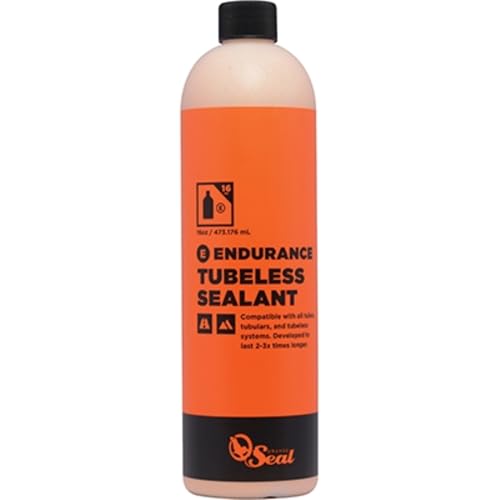
- Lasts 2–3 times longer than standard formulas
- Top-offs listed every 60–120 days
- Seals punctures and slices up to stated sizes
Best For: Endurance and gravel riders seeking fewer maintenance stops
Best High-Puncture Protection

- Seals punctures up to 7 mm
- Rated for pressures up to 110 psi
- Lasts approximately 3–6 months
Best For: Road, gravel, XC, and commuter bikes
Best Injector Kit

- Includes a 120 cc injector
- Seals punctures up to 6.5 mm
- Stays liquid for 3–7 months
Best For: Easy valve-stem application on Presta or Schrader setups
Best Cold-Weather Range

- Works from -25°C to +70°C
- Lasts 5–9 months or sometimes longer
- Uses concentrated latex and micro-fiber
Best For: Winter riders prioritizing low-temperature performance and longevity
Deep-Freeze Protection – Orange Seal Subzero Formula
For riders comparing bike tubeless sealants for winter riding, Orange Seal Subzero Formula is purpose-built for very cold conditions. This 16-ounce liquid refill is compatible with rubber and is designed for fat bike, MTB, road, cyclocross, and gravel tires.
Best For: Cyclists who need a dedicated cold-weather refill for rides down to -20°F.
Pros:
- Effective down to -20°F.
- Works across fat bike, MTB, road, CX, and gravel tires.
- 16-ounce refill provides a practical supply for maintenance.
Cons:
- Designed specifically as a refill, so application equipment may be needed.
- The supplied details do not specify a maximum puncture size or sealing speed.
Choose this formula when subzero performance is the priority. Its broad bike compatibility makes it a flexible winter-maintenance option, especially for riders who rotate between multiple tire types.
All-Temperature Versatility – Vittoria Universal Sealant
Vittoria Universal Tubeless Tire Sealant - Ammonia Free Sealant for All Bikes - 8.5 FL Oz - 250ml
Check Price On AmazonVittoria Universal is a practical choice for riders seeking bike tubeless sealants for winter riding without limiting use to one season. Its ammonia-free liquid formula works across high and low pressures and all temperature ranges for road, mountain, and gravel applications.
Best For: Riders wanting one ammonia-free sealant for mixed bikes, pressures, and temperatures.
Pros:
- Works across all temperature ranges and in both high- and low-pressure tires.
- Ammonia-free formula is compatible with road, MTB, and gravel use.
- Designed to seal punctures up to 7 mm and support air retention up to 1200 km.
- Thin liquid base targets small punctures while platelets help address larger openings.
Cons:
- Its 8.45-fluid-ounce bottle is smaller than several 16-ounce options.
- The supplied details do not identify a specific minimum operating temperature.
This is a versatile pick for riders who want year-round flexibility rather than a formula focused exclusively on severe cold. The 250 ml size suits topping up or maintaining a smaller number of tires.
Low-Pressure Trail Coverage – JOE'S NO FLATS Super Sealant
JOE’S NO FLATS Super Sealant is aimed at the high-volume, low-pressure tires often used for gravel and mountain biking. For bike tubeless sealants for winter riding, its stated operating range of -4°F to 158°F offers useful cold-weather coverage, while the formula is also suitable for tubes and tubulars.
Best For: Gravel and MTB riders running 20–70 PSI who want one sealant for tubeless, tubular, and tube setups.
Pros:
- Effective from -4°F to 158°F.
- Seals holes up to 6 mm in tubes, tubulars, and tubeless tires.
- Ready-to-use formula has a stated three-year shelf life and 6–8 months in-use life.
- 16.91-ounce packaging includes an applicator top for valve insertion.
Cons:
- The stated low-temperature range is warmer than some dedicated subzero formulas.
- Its recommended 20–70 PSI range may not suit every tire setup.
Consider this sealant when your winter riding centers on gravel or MTB tires at lower pressures. The long shelf life and applicator-oriented packaging also make it convenient for workshop storage and routine top-ups.
Extreme-Cold Latex-Free Protection – Bicycle Tire Sealant for Tube & Tubeless Use
This synthetic Bicycle Tire Sealant is built for riders comparing bike tubeless sealants for winter riding at especially low temperatures. It works down to -30°F, seals punctures up to 1/4 inch, and can be injected through the valve without unseating the tire.
Best For: Winter commuters, fat-bike riders, and cold-weather cyclists who want latex-free protection and valve-based application.
Pros:
- Remains effective down to -30°F.
- Seals punctures up to 1/4 inch, or approximately 6.35 mm.
- Works in both tube and tubeless bicycle tires.
- 16-ounce bottle treats four tires and includes a valve core removal tool.
Cons:
- The recommended approximately 4 fluid ounces per tire leaves no extra capacity beyond four treatments.
- Periodic checking and topping up are still recommended during the riding season.
Its exceptionally low temperature rating makes this a strong match for severe winter conditions. The valve-injectable design is especially useful when you want to add sealant without breaking the tire bead.
Fast-Sealing All-Rounder – Stan's NoTubes Original
For riders comparing bike tubeless sealants for winter riding, Stan’s NoTubes Original is a versatile option for road, gravel, mountain, cyclocross, and commuter tires. Its latex formula is designed to seal punctures quickly and remain liquid inside the tire for several months.
Best For: All-around riders who want broad tire compatibility and fast puncture sealing.
Pros:
- Seals punctures up to 6.5 mm (1/4 inch).
- Suitable for road, gravel, mountain, cyclocross, and commuter bikes.
- Can remain liquid for 2–7 months.
- Can be installed through the valve with Stan’s injector.
Cons:
- The supplied notes do not specify a minimum operating temperature.
- Valve installation requires the compatible injector.
Stan’s is a practical choice when fast sealing and wide-ranging compatibility matter most. For specifically cold-weather use, note that its supplied specifications do not provide a temperature rating.
Cold-Range Convenience – milKit Tubeless Sealant
Among bike tubeless sealants for winter riding, milKit stands out for its stated operating range down to -20°C/-2°F. Its synthetic latex and microfiber formula is ready to use without shaking and is designed to seal holes up to 6 mm.
Best For: Winter riders who prioritize a published low-temperature rating and easy handling.
Pros:
- Works from -20 to 50°C (-2 to 122°F).
- Requires no shaking before use because the microfibers stay suspended.
- Repairs tears and holes up to 6 mm (0.25 inch).
- Contains no ammonia or chemically aggressive ingredients, according to the supplied notes.
Cons:
- The supplied notes do not state how long the sealant remains liquid between top-offs.
- Its 1.07 kg listed item weight may be less convenient for carrying as a spare.
milKit is the clearest winter-focused pick in this group because it provides a specific cold-temperature range. The no-shake design also simplifies workshop or roadside handling.
Long-Lasting Endurance – Orange Seal Endurance
Orange Seal Endurance is a strong contender among bike tubeless sealants for winter riding when reducing maintenance is a priority. Its latex formula is designed to last two to three times longer than standard sealants, with top-offs listed at roughly 60–120 days.
Best For: Endurance, gravel, and mountain riders who want longer intervals between sealant maintenance.
Pros:
- Designed to last 2–3 times longer than standard formulas.
- Listed top-off interval is 60–120 days.
- Seals punctures up to 1/4 inch and slices up to 1/2 inch.
- Uses biodegradable ingredients and is compatible with major tubeless-ready and UST tire brands.
Cons:
- The supplied notes do not provide a specific minimum temperature rating.
- Long-lasting performance still requires periodic top-offs.
Choose Orange Seal Endurance if you want a durable formula that can reduce service frequency while handling larger punctures and slices. Riders in very cold conditions should verify temperature suitability, since no operating range is listed in the supplied details.
Best High-Puncture Protection – Muc-Off Road & Gravel Sealant
For riders comparing bike tubeless sealants for winter riding, Muc-Off’s Road & Gravel formula offers broad road, gravel, XC, and commuting coverage. Its synthetic latex and bamboo particles are designed to seal punctures up to 7 mm, including at pressures up to 110 psi.
Best For: Road, gravel, XC, and commuter riders who want strong puncture-sealing capability and a 500 ml refill size.
Pros:
- Seals punctures up to 7 mm and helps address porous tires and bead or rim gaps.
- Designed for pressures up to 110 psi.
- Can last approximately 3–6 months per application.
- Non-corrosive formula is designed to wash off easily during refills.
Cons:
- Its stated lifespan may require more frequent maintenance than longer-lasting formulas.
- It is specifically optimized for road, gravel, XC, and commuting rather than every riding discipline.
Choose this option if sealing capacity and compatibility with higher-pressure road and gravel setups matter most. The 500 ml size is also practical for riders planning multiple refills.
Best Injector Kit – 500 ml Sealant with Injector
For bike tubeless sealants for winter riding, this 500 ml option stands out for its included application tools. The injector delivers sealant through the valve stem on mounted tires, helping riders add sealant without removing the tire bead.
Best For: Cyclists who prioritize convenient roadside or at-home sealant installation for both Presta and Schrader valves.
Pros:
- Includes a 120 cc injector and valve core removal tool.
- Seals punctures up to 1/4 inch, or approximately 6.5 mm.
- Stays liquid in tires for a stated 3–7 months.
- Works through the valve stem without removing the bead from the rim.
Cons:
- Its maximum stated puncture size is smaller than the 7 mm rating of some alternatives.
- The notes do not specify a temperature range for winter conditions.
This is a practical pick when easy application is more important than specialized cold-weather claims. The included injector and valve tool make routine replenishment straightforward.
Best Cold-Weather Range – NOVATOR Endurance Sealant
Among bike tubeless sealants for winter riding, NOVATOR Endurance is notable for its stated operating range of -25°C to +70°C. Its concentrated latex and added micro-fiber are designed to seal punctures quickly while remaining injectable through the valve stem.
Best For: Riders seeking a sealant with an explicitly stated low-temperature range and extended liquid life.
Pros:
- Designed to work from -25°C to +70°C.
- Can remain liquid for 5–9 months, and in some cases up to 12 months.
- Seals punctures up to 1/4 inch, or approximately 6.5 mm.
- Micro-fiber is intended to improve sealing while maintaining smooth injection.
Cons:
- Dosage varies substantially by tire size, so larger tires require more sealant.
- Its stated maximum puncture size is slightly below the 7 mm claim of the Muc-Off option.
NOVATOR is the strongest match here for riders who specifically want documented low-temperature capability and longer service intervals. Its 34-ounce format can also support multiple tire applications.
How We Picked the Best Bike Tubeless Sealants for Winter Riding
We focused on sealants suited to common bicycle tubeless setups, including mountain, gravel, road, cyclocross, fat-bike, tubular, and tube applications where specified. Our comparison emphasizes published temperature claims, reported puncture-sealing capacity, expected service life, compatibility considerations, and practical handling.
Cold-weather suitability matters, but it is only one part of the decision. A formula that works at very low temperatures may not be the best choice for a warm-climate rider, while a long-lasting endurance formula can be more convenient for riders who check their tires less often.
Quick Comparison
- Best for subfreezing conditions: Choose a sealant with an explicit low-temperature rating, especially for fat-bike or consistently below-freezing use.
- Best for everyday mixed riding: Universal formulas offer a practical balance of sealing speed, compatibility, and maintenance.
- Best for extended service intervals: Endurance formulas are designed to remain effective longer between top-ups, though periodic checks are still necessary.
- Best for larger punctures: Look for a product that clearly states its maximum sealing size and match it to your tire pressure and terrain.
- Best for sensitive setups: Ammonia-free or latex-free options may be preferable for riders concerned about rim materials, allergies, or sealant handling.
Key Buying Factors for Bike Tubeless Sealants for Winter Riding
Temperature Performance
Check the stated operating range rather than assuming every sealant is winter-ready. Freezing conditions can slow liquid movement and reduce sealing speed. If you regularly ride below 32°F, prioritize a formula with a specific cold-weather claim.
Sealing Speed and Puncture Size
Fast-sealing formulas are useful on rocky trails and high-mileage gravel routes, but advertised puncture limits are not guarantees. Tire pressure, hole shape, sealant volume, and wheel rotation all affect results.
Longevity and Maintenance
Sealant gradually dries, especially in warm or dry environments. Endurance formulas may reduce refill frequency, but winter storage and seasonal temperature changes still justify checking the liquid every few weeks or before important rides.
Compatibility and Cleanup
Confirm whether the product is intended for tubeless tires, tubes, tubulars, or all three. Also consider ammonia-free and latex-free formulas if you have material or skin sensitivities. Follow the manufacturer’s recommended amount and injection method.
Who Should Buy Which Bike Tubeless Sealants for Winter Riding?
Cold-climate and fat-bike riders should start with a specifically low-temperature formula. Mountain bikers and aggressive gravel riders should prioritize rapid sealing and a stated ability to handle larger punctures. Road and endurance riders may prefer a clean, long-lasting formula that minimizes maintenance.
Riders sharing one sealant across several bikes should choose a versatile, broadly compatible product. Those who dislike frequent servicing should consider an endurance option, while riders sensitive to latex or ammonia should select a clearly labeled alternative. Whatever you choose, install enough sealant for the tire volume, rotate the wheel after filling, and inspect the setup regularly throughout winter.