Building a serious home gym does not require a full-size training room. The best power racks for small spaces use folding frames, wall-mounted designs, or integrated cable systems to deliver versatile strength training while preserving valuable floor area.
We compared these 10 options by footprint, storage flexibility, training features, adjustment range, and suitability for different home-gym layouts. Use the guide below to identify the right balance of stability, versatility, and space efficiency.
Best 10 Power Racks for Small Spaces Picks for 2026
Best Wall-Mounted Pick

- Folds to a 2-inch-deep profile
- 1,000-pound stated capacity
- Includes pull-up and T-bar attachments
Best For: Wall-mounted training with fast storage
Best Full-Size Option
Sunny Health & Fitness Power Rack

- 18-point J-hook adjustment
- Built-in Olympic plate storage
- 87-inch-tall freestanding design
Best For: Compact rooms with room for a permanent rack
Best Adjustable Wall Rack
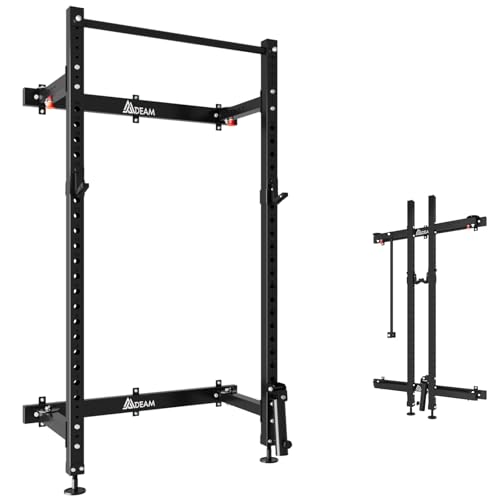
- 25-inch open depth and foldable design
- 1,000-pound stated capacity
- Includes landmine, pull-up bar and J-hooks
Best For: Garage or basement gyms needing flexible storage
Best Cable-Crossover Cage
SunHome Power Cage with Pulley System

- 28 adjustable J-hook and spotter positions
- Integrated pulley and cable crossover
- Four plate posts and two barbell hooks
Best For: Versatile home gyms with moderate floor space
Best Wall-Folding Pick
JELENS FS01 Folding Squat Rack
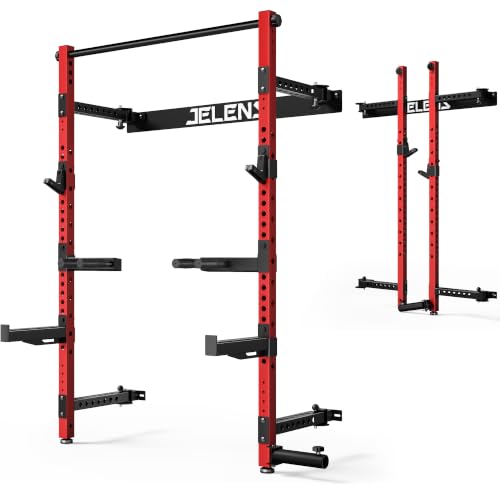
- Folds to a reported 2.08 square feet
- Includes safety bars, J-hooks, pull-up bar, and landmine
- Wall-mounted design preserves floor space
Best For: Compact home gyms needing a fold-away barbell rack
Best Cable-System Pick
Folding Squat Rack with Dual Pulleys

- Adds a dual 1:1 cable pulley system
- Folds away and has seven adjustable angles
- Combines rack, pulleys, pull-up bar, and landmine
Best For: Compact households wanting versatile cable and barbell workouts
Best Full-Size Training Station
ULTRA FUEGO Multi-Functional Power Cage

- Includes pulley, dip, landmine, storage, and safety attachments
- Listed 1,000-pound capacity with reinforced steel construction
- Offers adjustable positions for several training components
Best For: Dedicated home or garage gyms needing an all-in-one cage
Best Folding Option

- Folds to 4.3 sq. ft. for storage
- Five configurations with dual pulleys
- Supports up to 2,000 pounds
Best For: Apartments and compact rooms needing foldaway storage
Best Full-Cage Choice
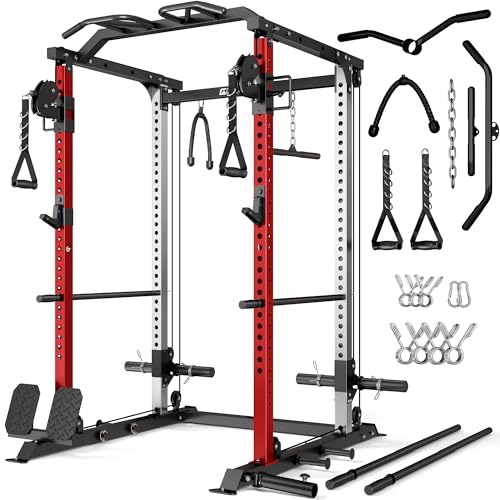
- 17.88-square-foot listed footprint
- Full cage plus dual independent pulleys
- 31 cable and 29 rack adjustment points
Best For: Compact home gyms wanting full-cage training
Best Value Footprint

- Compact 12.5-square-foot footprint
- Includes pulley, landmine, and cable attachments
- 13 height positions and 2,000-pound capacity
Best For: Compact freestanding home gyms on a practical budget
Best Wall-Mounted Pick – Mikolo Folding Squat Rack
If you need power racks for small spaces, the Mikolo Folding Wall Mounted Squat Rack is designed to turn unused wall space into a capable training station. It folds from a 19.7-inch-deep open position to a 2-inch-deep stored profile and is rated for up to 1,000 pounds.
Best For: Home gym users who want a wall-mounted rack that folds away quickly while still supporting squats, bench presses, deadlifts, pull-ups and rows.
Pros:
- Folds between storage and workout positions in about 15 seconds.
- Uses 2-by-2-inch, 13-gauge steel uprights with a stated 1,000-pound capacity.
- Includes a pull-up bar, J-cups with UHMW plastic inserts and a dual-size T-bar row attachment.
- Includes a stringer and metal studs for installation, with an estimated 15- to 30-minute setup.
Cons:
- Wall mounting is required, so the installation surface must be suitable for the included hardware.
- The open configuration extends about 19.7 inches from the wall and is 85.8 inches tall.
With its very shallow folded profile and included attachments, the Mikolo is a strong fit when reclaiming floor space is the main priority. Verify wall structure, ceiling clearance and the available workout depth before buying.
Best Full-Size Option – Sunny Health & Fitness Power Rack
The Sunny Health & Fitness Full Size Power Rack offers a conventional freestanding setup for home strength training. Among power racks for small spaces, it is better suited to a compact room or garage that can accommodate its 38-by-53-inch footprint and 87-inch height.
Best For: Lifters who want one full-size rack for squats, presses, bench work, pull-ups and resistance-band exercises, plus built-in plate storage.
Pros:
- Provides 18 J-hook adjustment points for varied lifting positions.
- Includes safety lock spotter arms and an eight-position angled pull-up bar.
- Built-in plate holders help keep Olympic plates organized.
- Supports up to 300 pounds on the pull-up bar, J-hooks and spotter arms, with 100 pounds per plate holder.
Cons:
- Its full-size footprint takes more floor space than a folding wall-mounted rack.
- Compatible attachments are sold separately.
- The listed warranty is one year plus a 180-day manufacturer warranty.
This rack makes sense when you want a traditional cage and have enough room for a permanent setup. Its adjustable points and storage features add versatility, but measure the 87-inch height and surrounding clearance carefully.
Best Adjustable Wall Rack – MDEAM Folding Squat Rack
The MDEAM Folding Squat Rack is a practical choice for power racks for small spaces because it mounts to the wall and folds to reduce its intrusion when not in use. It opens to a 25-inch depth, reaches 87 inches high and includes leveling feet for uneven floors or mounting adjustments.
Best For: Garage, basement and home gym users seeking a wall-mounted rack with pull-up, landmine and barbell-training capability.
Pros:
- Switches between its stored and workout configurations in about 15 seconds.
- Uses 60-by-60mm steel uprights and carries a stated 1,000-pound capacity.
- Includes J-hooks, a pull-up bar and a 360-degree landmine attachment.
- Stabilizer leveling feet provide some vertical adjustment on uneven floors or installations.
Cons:
- Wall mounting is required and the rack reaches 87 inches in height.
- The 25-inch open depth needs to remain clear during workouts.
- The listed warranty is one year.
The MDEAM stands out for combining fold-away storage with useful built-in attachments and leveling support. It is a good space-conscious alternative to a full cage, provided your wall and ceiling can accommodate the installation.
Best Cable-Crossover Cage – SunHome Power Cage with Pulley System
The SunHome Power Cage adds a pulley system and adjustable cable crossover to a half-cage-style strength station. It is not the most compact option among power racks for small spaces, with a listed 46.9-inch depth, 42.4-inch width and 84.9-inch height, but its integrated features can reduce the need for separate equipment.
Best For: Home gym users who have room for a broader multi-exercise station and want barbell work, pull-ups, dips, cable training and organized plate storage.
Pros:
- Offers 28 adjustable positions for J-hooks and spotter arms.
- Includes a pulley system, adjustable cable crossover, dip handles and weight plate storage.
- Has four weight plate storage posts and two barbell storage hooks.
- The power cage is rated for up to 1,500 pounds, while the listed bench capacity is 660 pounds.
Cons:
- Its 46.9-inch depth and 42.4-inch width require more floor space than folding racks.
- The product is listed as a half power cage, so it may not suit shoppers seeking a fully enclosed rack.
- The listed warranty is one year.
The SunHome is best viewed as a space-efficient equipment consolidation choice rather than a minimum-footprint rack. Its cable and storage features may justify the larger footprint for users building a versatile home gym.
Best Wall-Folding Pick – JELENS FS01 Folding Squat Rack
If you need power racks for small spaces, the JELENS FS01 is designed to preserve floor area without giving up core barbell-training features. It folds flat against the wall to a reported 2.08 square feet and opens in about 15 seconds. The rack includes J-hooks, safety bars, a pull-up bar, and a 360° landmine attachment.
Best For: Home gyms that need a compact wall-mounted rack for squats, bench presses, pull-ups, and other barbell exercises.
Pros:
- Folds flat when not in use, with a compact 5.9-inch folded depth.
- Uses 2-by-2-inch steel tubing and wall mounting for a stable setup.
- Includes safety bars, J-hooks, pull-up capability, and a landmine attachment.
- Offers multiple front and side hole positions for attachment adjustment.
Cons:
- Wall installation is required, and the manufacturer recommends two people for setup.
- The supplied details list a 111-pound maximum weight capacity, so buyers should verify whether that figure fits their intended training.
The JELENS FS01 stands out when storage space is the main concern. Its fold-away design is particularly practical for multipurpose rooms, provided you have a suitable wall and carefully follow the installation instructions.
Best Cable-System Pick – Folding Squat Rack with Dual Pulleys
For shoppers comparing power racks for small spaces, this folding squat rack combines a wall-mounted cage with a dual cable pulley system. It folds for storage, provides seven adjustable angles, and adds cable crossover, lat pulldown, pull-up, and landmine functions in one setup.
Best For: Families or compact home gyms that want varied full-body training and independent cable movements from one wall-mounted unit.
Pros:
- Dual pulley system uses a 1:1 ratio for independent crossover movements.
- Folds away and offers seven adjustable angles for space-conscious setups.
- Built with 2-by-2-inch, 14-gauge steel and reinforced wall mounts.
- Combines a power rack, cable crossover, lat pulldown, pull-up bar, and landmine.
Cons:
- The package weighs 151 pounds, which may make installation and handling more demanding.
- Because it is wall-mounted, the installation surface and mounting process require careful attention.
This model is a strong choice when exercise variety matters as much as footprint. Its pulley system adds more functionality than a basic folding rack, while the folding frame helps keep the training area usable between workouts.
Best Full-Size Training Station – ULTRA FUEGO Multi-Functional Power Cage
Among power racks for small spaces, the ULTRA FUEGO power cage is the least compact option here, but it packs substantial functionality into one station. Its listed outside dimensions are 63 inches deep by 47 inches wide by 82.8 inches high, with included pulley equipment, storage pegs, dip handles, safety bars, and a landmine attachment.
Best For: Home or garage gyms with enough dedicated room for a full-size cage and a broad range of strength-training attachments.
Pros:
- Reported 1,000-pound capacity with 50-by-50-millimeter uprights and wide steel bases.
- Includes a pulley system, lat pulldown bar, dip handles, J-hooks, safety bars, and landmine.
- Provides six weight-plate storage pegs and four band pegs.
- Offers adjustable J-hook, safety-bar, and dip-handle positions.
Cons:
- Its 63-inch depth and 47-inch width require more floor space than folding wall-mounted racks.
- A large accessory package may make assembly and layout more involved.
The ULTRA FUEGO is best viewed as a complete training station rather than a minimalist space saver. It makes sense for buyers who have a dedicated corner or garage area and want to consolidate many exercises and accessories into one sturdy cage.
Best Folding Option – WM3-V4 Folding Squat Rack
For shoppers comparing power racks for small spaces, the WM3-V4 stands out because it folds down to 4.3 square feet for storage and expands to 12.3 square feet when deployed. Its wall-mounted design combines rack, pulley, pull-up, and cable-training functions in one adaptable station.
Best For: Apartments, garages, or basements where reclaiming floor space after workouts is a priority.
Pros:
- Folds compactly for storage and offers five training configurations.
- Combines a squat rack, dual independent pulleys, pull-up bar, and cable crossover.
- Offers 15 pulley-height adjustments and supports a stated maximum of 2,000 pounds.
Cons:
- Wall mounting and installation are required.
- The supplied warranty is limited to one year.
- It ships in two boxes, so setup may require coordinating multiple packages.
The WM3-V4 is the most storage-conscious choice in this group. Choose it if a folding wall-mounted system matters more than having a freestanding full cage.
Best Full-Cage Choice – DP01 Compact Power Cage
The DP01 is a strong contender among power racks for small spaces, combining a full power cage with a cable crossover, lat pulldown, low row, pull-up bar, and landmine. Its listed footprint is 17.88 square feet, while the 47.64-inch interior provides room for in-cage bench pressing.
Best For: Home gyms that need full-cage safety and broad cable-training capability in one freestanding unit.
Pros:
- Combines a full cage with dual independent pulleys and multiple training stations.
- Provides 31 cable-height choices and 29 adjustment points for J-hooks and safety bars.
- Uses 2-by-2-inch steel tubing and has a stated 2,000-pound capacity.
- Includes useful accessories such as a lat bar, triceps rope, T-bar, safety bars, and J-hooks.
Cons:
- Its 57.87-by-46.46-by-84.25-inch dimensions require careful room planning.
- It is less collapsible than a wall-mounted folding rack.
- It ships in two boxes and requires assembly.
The DP01 offers the broadest adjustment range and a true full-cage setup here. It is a practical pick when safety-bar positioning and exercise variety outweigh the need for the smallest possible footprint.
Best Value Footprint – S11 Multi-Function Power Cage
The S11 keeps its listed footprint to 12.5 square feet, making it one of the more compact power racks for small spaces. It pairs a squat cage with a lat pulldown, adjustable pulley system, landmine, pull-up station, and several included cable attachments.
Best For: Home gym users who want a compact freestanding cage with core cable and attachment options.
Pros:
- Uses a 12.5-square-foot footprint with a 57.5-by-44.5-by-79.7-inch cage size listed in the product notes.
- Includes lat, cable, T-bar, and pull-down bars, plus J-hooks, safety rods, and a landmine.
- Its pulley system is designed for smoother, quieter operation.
- Offers 13 numbered height positions and a stated 2,000-pound capacity.
Cons:
- It has fewer adjustment positions than the DP01.
- The one-year warranty is shorter than the DP01’s two-year warranty.
- It ships in two boxes and requires assembly.
The S11 balances footprint, attachments, and basic cable functionality well. It is a sensible choice for shoppers who want a freestanding cage without moving up to the DP01’s larger listed footprint.
How We Picked the Best Power Racks for Small Spaces
We focused on racks designed for home gyms where floor space, ceiling height, and equipment storage matter. The selection includes folding and wall-mounted models, as well as more substantial cages that add cable stations, pull-up work, dip training, or plate storage. We also considered the practical details that affect everyday use: rack adjustability, attachment compatibility, pulley functionality, installation requirements, and the amount of clearance needed around the frame.
Advertised weight capacities are useful for comparison, but they should not be treated as the only measure of safety or quality. Proper anchoring, assembly, flooring, and user technique are essential, particularly with wall-mounted and folding racks.
Quick Comparison
| Rack type | Best for | Main advantage | Potential trade-off |
|---|---|---|---|
| Folding wall-mounted | Very limited floor space | Stores close to the wall between workouts | Requires careful installation and clearance planning |
| Compact squat rack | Basic barbell training | Simple, space-efficient setup | Usually fewer cable and accessory features |
| Full power cage | Frequent heavy training | More enclosed support and exercise options | Uses more floor and overhead space |
| Cable-equipped rack | Full-body home workouts | Adds pulldowns, rows, crossovers, and accessory work | More assembly complexity and moving parts |
Key Buying Factors for Power Racks for Small Spaces
Measure the Complete Setup
Check the rack’s folded and open dimensions, then add room for the barbell, weight plates, bench movement, and cable handles. Confirm ceiling height before choosing a model with a pull-up bar or lat-pulldown tower.
Choose the Right Mounting or Support Style
Wall-mounted racks need a suitable structural surface and secure hardware. Folding models are excellent space savers, but they must be anchored correctly and opened fully before loading. Freestanding cages may be easier to reposition but typically require more floor area.
Match Features to Your Training Plan
If your routine centers on squats, presses, and rack pulls, a straightforward rack with dependable J-hooks and safeties may be enough. Cable systems, dip handles, landmine attachments, and storage posts add versatility, but they also increase cost, installation demands, and the space needed during use.
Check Adjustment and Compatibility
Look for useful height positions, secure safeties, appropriately sized uprights, and attachment compatibility with the included hardware. Review whether the rack is intended for standard or Olympic bars and whether plates, bench, pulley components, and mounting hardware are included.
Who Should Buy Which Power Racks for Small Spaces?
Choose a folding wall-mounted rack if reclaiming floor space is your top priority and you can install it into a suitable wall structure. A compact squat rack is a practical choice for beginners or lifters who mainly perform barbell basics. Choose a full cage when stability, enclosed safeties, and frequent heavy training matter more than the smallest footprint.
A cable-equipped option suits households wanting one central station for strength and accessory exercises, provided there is enough room to operate the pulleys. Multi-function models with dip, landmine, pulley, and storage features are best for users who will regularly use those attachments rather than paying for unused complexity. Before ordering, verify dimensions, anchoring requirements, capacity claims, and the manufacturer’s assembly instructions.