The right saddle bag can add meaningful cargo space without the bulk of a rack or pannier setup. For bikepacking, the best options balance capacity, weather protection, stability, and easy installation.
We’ve gathered 10 saddle bags ranging from compact roll bags to expandable 15-liter packs, helping you match your gear, route, and bike to a practical storage solution.
Best 10 Bike Saddle Bag for Bikepacking Picks for 2026
Best Adjustable Capacity
ROCKBROS 14L Waterproof Seat Pack
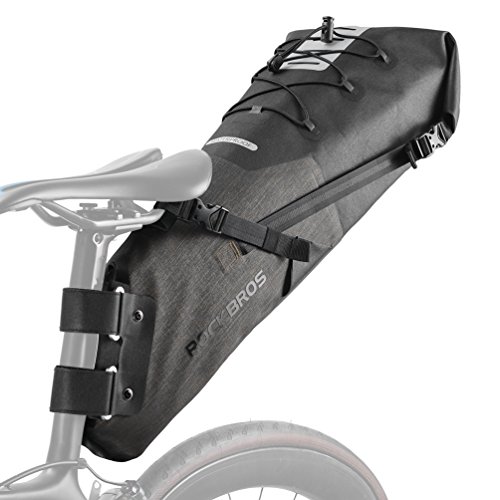
- Adjustable roll-top capacity up to 14L
- Waterproof, wipe-clean three-layer material
- Reflective straps and tool-free mounting
Best For: Large, flexible loads on mixed-weather bikepacking trips
Best Stable Rack-Free Option

- Roomy 10L capacity for touring gear
- Removable 10,000 mm waterproof liner
- Compression straps help reduce sway
Best For: Rack-free touring loads up to 5 kg
Best Compact Premium Roll
Brooks England Scape Saddle Roll Bag

- Compact 1L capacity for essential items
- IPX4 waterproof welded construction
- Adjustable attachments and easy-pull zipper
Best For: Minimalist wet-weather rides
Best for Night Visibility
Rhinowalk 13L Waterproof Saddle Bag

- 13L capacity for medium and long rides
- 3000 mm waterproof inner fabric
- Reflective details and tail-light hook
Best For: Commuting and bikepacking in wet or low-light conditions
Expandable 3L Pick
ROCKBROS Bikepacking Saddle Bag

- Expandable storage holds about 3 liters
- Water-repellent welded 600D polyester and TPU construction
- Reflective elements and three-strap mounting
Best For: Day rides and lightweight bikepacking loads
High-Capacity Rainy-Route Pick
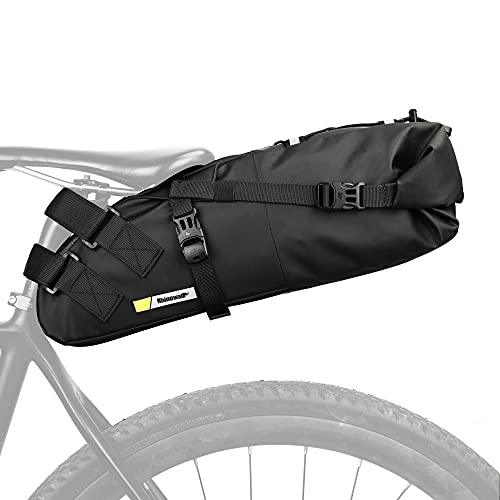
- 10-liter capacity for medium and long rides
- 3000mm waterproof fabric and waterproof rubber seam strip
- Four-point mounting with reflective details
Best For: Longer rides, commuting, and wet-weather touring
Hardshell Stability Pick
Rhinowalk 14L Waterproof Saddle Bag

- Structured two-piece hardshell design
- 14L heat-sealed waterproof interior
- Rear-light mounting points
Best For: Bikepackers wanting a stable, structured saddle bag
Compression and Visibility Pick
KEMIMOTO 13-15L Expandable Seat Bag

- Expandable 13-15L roll-top capacity
- Air-release valve for compression
- Reflective panels and light mount
Best For: Riders needing adjustable storage for wet-weather trips
All-Weather Utility Pick
15L Adjustable Bikepacking Seat Bag

- Adjustable roll-top capacity up to 15L
- Three-layer waterproof fabric
- Steel support frame and rear flap
Best For: Bikepackers wanting versatile storage for mixed-weather rides
Best Adjustable Capacity – ROCKBROS 14L Waterproof Seat Pack
For riders seeking a versatile bike saddle bag for bikepacking, the ROCKBROS seat pack offers adjustable capacity up to 14 liters. Its roll-top closure lets you adapt the storage space for tools, clothing, and other short-distance essentials.
Best For: Bikepackers who want one large, adjustable bag for road, mountain, and mixed-weather rides.
Pros:
- Roll-top design adjusts capacity up to 14 liters.
- Waterproof three-layer construction is easy to wipe clean.
- Tool-free strap mounting, reflective details, and a built-in fender function add practical versatility.
Cons:
- One main compartment provides less organization than a multi-pocket design.
- Its large capacity may be more than needed for minimalist rides.
The ROCKBROS is a strong choice when flexible storage matters most. Built-in steel around the usable panel helps the bag retain its shape, while the waterproof material and reflective straps suit changing conditions and low-light cycling.
Best Stable Rack-Free Option – Topeak BackLoader
The Topeak BackLoader is a practical bike saddle bag for bikepacking when you need rack-free storage for longer rides. It combines a roomy 10-liter format with a removable waterproof liner and compression straps designed to limit movement.
Best For: Touring and bikepacking riders carrying up to 5 kg of gear without installing a rear rack.
Pros:
- 10-liter capacity accommodates tools, food, clothing, and other touring gear.
- Removable 10,000 mm-rated dry bag helps protect contents from rain, mud, and grit.
- Compression straps and the upgraded saddle mount help reduce sway.
Cons:
- At 480 g, it is heavier than smaller saddle bags.
- The single-compartment design offers limited built-in organization.
With durable polyethylene and nylon fabric, an air release valve, and a stated 5 kg carrying capacity, the BackLoader is geared toward substantial loads. Its mounting and compression features make stability a central advantage for rougher routes.
Best Compact Premium Roll – Brooks England Scape Saddle Roll Bag
Brooks England Scape Saddle Roll Bag, Cycling and Gravel Bag, Mud Green, One Size
Check Price On AmazonThe Brooks England Scape Saddle Roll Bag is a compact bike saddle bag for bikepacking for riders who prefer a streamlined setup. Its 1-liter capacity focuses on essential items, while welded waterproof materials and an easy-pull zipper support dependable everyday use.
Best For: Minimalist cyclists carrying small essentials on wet-weather rides.
Pros:
- Compact 1-liter format avoids the bulk of larger seat packs.
- IPX4-rated waterproof construction uses welded materials and weatherproof details.
- Adjustable attachments and a zippered closure make access straightforward.
Cons:
- One-liter capacity is unsuitable for large bikepacking loads.
- One main compartment limits separation of smaller items.
The Scape Saddle Roll Bag prioritizes compactness, weather resistance, and durable components over maximum storage. It is a sensible pick for tools and other essentials when keeping the bike light and uncluttered is more important than carrying clothing or camping gear.
Best for Night Visibility – Rhinowalk 13L Waterproof Saddle Bag
The Rhinowalk 13L is a capable bike saddle bag for bikepacking designed for medium- and long-distance cycling. Its waterproof inner bag, four-point strap system, and external elastic rope provide room for gear while helping secure items over bumps.
Best For: Road, mountain, folding-bike, and commuting riders who need substantial waterproof storage with visibility features.
Pros:
- 13-liter capacity stores gear for medium- and long-distance rides.
- 3000 mm waterproof inner fabric and sealed needle-strip protection help resist heavy rain.
- Four-point mounting, reflective details, and a tail-light hook improve practicality and visibility.
Cons:
- One main compartment provides limited organization.
- The larger format may be excessive for short commutes or minimalist setups.
The Rhinowalk balances high capacity with weather protection and nighttime safety touches. Its cross elastic rope can hold a pump, wet clothing, or helmet externally, making it useful when internal space is already occupied.
Expandable 3L Pick – ROCKBROS Bikepacking Saddle Bag
If you want a compact bike saddle bag for bikepacking, the ROCKBROS model offers about 3 liters of adjustable storage. Its expandable design, external elastic cords, and three-point mounting make it practical for carrying smaller cycling essentials without a rear rack.
Best For: Day rides and lightweight bikepacking setups that need organized, adjustable storage.
Pros:
- Expandable capacity of approximately 3 liters.
- 600D polyester and TPU fabric with welded, water-repellent seams.
- Three-strap triangular mounting structure helps limit movement.
- Reflective elements and a rear taillight attachment point improve visibility.
Cons:
- Its 3-liter capacity is smaller than the other bags in this roundup.
- Installation requires seven steps.
The ROCKBROS is a sensible choice when you prefer a smaller seat bag with useful expansion and visibility features. It is better suited to streamlined loads than extended trips requiring maximum capacity.
High-Capacity Rainy-Route Pick – Rhinowalk 10L Saddle Bag
The Rhinowalk is a high-capacity bike saddle bag for bikepacking designed for medium- and long-distance rides. Its 10-liter compartment, waterproof construction, and external cross elastic rope provide room for clothing, tools, and other touring necessities.
Best For: Longer rides, commuting, and touring where waterproof storage and extra capacity matter.
Pros:
- 10-liter capacity accommodates supplies for medium- and long-distance cycling.
- PVC polyester construction and 3000mm waterproof inner fabric help resist heavy rain.
- Four-point strap installation with buckles helps reduce loosening over bumps.
- Reflective details and a tail light hook support nighttime visibility.
Cons:
- It has one main compartment rather than multiple compartments.
- The larger capacity may be more than needed for short, minimalist rides.
Choose the Rhinowalk if your packing list extends beyond basic ride essentials. Its weather protection and four-point attachment system make it a strong option for practical, higher-volume bikepacking storage.
Maximum Expandability Pick – KEMIMOTO 11–13L Seat Bag
For riders carrying a substantial load, the KEMIMOTO is a large bike saddle bag for bikepacking that expands from 11 to 13 liters. Its roll-top design, welded PVC construction, rigid bottom panels, and rack-free installation are geared toward longer rides.
Best For: Long-distance cycling and riders who want maximum under-seat capacity without adding a rear rack.
Pros:
- Roll-top capacity expands from 11 to 13 liters.
- Double-layer PVC fabric and welded seams provide waterproof, leak-resistant storage.
- Four bottom panels add rigidity and help the bag retain its shape.
- Reflective panels and a rear-light attachment point support nighttime riding.
Cons:
- At 0.58 kg, it is heavier than the listed ROCKBROS bag.
- The rear light is not included.
- Its large size may be excessive for short rides or minimal loads.
The KEMIMOTO stands out for riders who need the most storage in this group. Its expandable waterproof body and sturdy support panels make it well suited to extended trips, though the larger format adds weight and bulk.
Hardshell Stability Pick – Rhinowalk 14L Waterproof Saddle Bag
If you want a bike saddle bag for bikepacking with a structured profile, the Rhinowalk BHD0020 combines a hardshell frame with a 14L waterproof storage pouch. Its two-piece, screw-free mounting system uses Velcro and bundled straps to help keep the load stable.
Best For: Riders who prefer a structured 14L bag with versatile mounting points and a hard-shell frame.
Pros:
- Two-piece hardshell-and-bag design installs without screws.
- 210D heat-sealed interior and water-resistant materials help protect gear.
- Mounting holes allow space for a rear light or small accessories.
- 14L capacity accommodates much of the gear needed for longer rides.
Cons:
- The hardshell construction may be less compressible than a fully soft bag.
- Its white finish may show dirt more readily on muddy rides.
The Rhinowalk stands out when stability and structure matter more than maximum packability. Check your seat and mounting setup for compatibility before ordering.
Compression and Visibility Pick – KEMIMOTO 13-15L Expandable Seat Bag
The KEMIMOTO is a practical bike saddle bag for bikepacking when adjustable capacity and wet-weather protection are priorities. Its 500D PVC-coated fabric, welded seams, roll-top closure, and air-release valve help you pack and compress the load for different rides.
Best For: Riders who need an expandable, rack-free seat bag with compression features and enhanced nighttime visibility.
Pros:
- 13-15L expandable capacity adapts to shorter or longer trips.
- Welded seams and a roll-top closure provide waterproof construction.
- Air-release valve helps reduce excess air and bulk.
- Reflective PVC panels and a dedicated rear-light mount improve visibility options.
Cons:
- The rear light is not included.
- At approximately 0.6 kg, it adds measurable weight to the bike.
- Its soft construction may offer less rigidity than a hardshell design.
With compression control, a carry handle, and a tool-free seat mount, the KEMIMOTO is well suited to riders who want one bag for changing loads and mixed conditions.
All-Weather Utility Pick – 15L Adjustable Bikepacking Seat Bag
This 15L model is a versatile bike saddle bag for bikepacking, commuting, and touring. Its roll-top design adjusts the packed volume, while the three-layer waterproof fabric, built-in steel support frame, and extended rear flap add practical protection for variable conditions.
Best For: Riders seeking adjustable storage with a supportive structure, reflective details, and a mud-reducing rear flap.
Pros:
- Roll-top closure lets you adjust the capacity up to 15L.
- Three-layer waterproof fabric has a smooth, easy-to-wipe surface.
- Tool-free buckles and adjustable straps fit several bicycle types.
- Steel support frame helps maintain shape, while reflective signs and a tail-light belt support visibility.
Cons:
- At approximately 0.7 kg, it is heavier than some soft saddle bags.
- The soft shell may not protect contents as rigidly as a hard case.
- The supplied notes do not specify whether a rear light is included.
The combination of adjustable packing space, waterproof materials, and a built-in support frame makes this a strong general-purpose option for riders carrying clothing, tools, or daily essentials.
How We Picked the Best Bike Saddle Bag for Bikepacking
We focused on the features that matter most on loaded rides: usable capacity, water resistance or waterproof construction, attachment security, compatibility with different saddles and seatposts, and access to packed gear. The selection includes seat packs for minimalist overnighters, larger bags for multi-day trips, and models that can also support commuting or general touring.
Because product specifications and fit can vary, check the listed dimensions, mounting requirements, and maximum load before buying. A 15-liter bag may offer more storage, but it can also require careful packing and stronger stabilization to prevent sway.
Quick Comparison
| Type | Best for | What to prioritize |
|---|---|---|
| Compact saddle or roll bag | Short rides and lightweight overnighters | Low weight, simple access, secure straps |
| 10–13L seat pack | Weekend bikepacking | Compression, water resistance, saddle clearance |
| 14–15L expandable pack | Longer trips and bulky sleep systems | Stability, load support, durable construction |
| Rack-compatible or hardshell design | Mixed touring and commuting | Mounting compatibility and rigid support |
Key Buying Factors for a Bike Saddle Bag for Bikepacking
Capacity and Packing Style
Choose capacity based on your equipment rather than the advertised maximum alone. A 10L bag may handle clothing, a bivy, and small essentials, while 13–15L models provide more room for bulkier layers or sleeping gear. Roll-top and expandable designs let you compress partially filled bags and reduce movement.
Weather Protection
Waterproof fabrics, welded seams, and roll-top closures offer better protection than basic water-resistant materials. Even with a weatherproof bag, place sensitive items such as electronics and spare clothing in dry bags or liners for extended wet rides.
Stability and Bike Fit
A loaded saddle pack should stay clear of the rear tire, seatpost, and your legs. Look for multiple attachment points, compression straps, and anti-sway support. Confirm that your saddle rails and seatpost leave enough space for the mounting system, especially on full-suspension bikes or bikes with short seatposts.
Access, Weight, and Durability
Frequent-access items are easier to reach in a smaller accessory pouch, while a large saddle bag works best for gear you use less often. Reinforced panels and abrasion-resistant materials can improve longevity, but they may add weight. Pack dense items low and toward the front of the bag to improve handling.
Who Should Buy Which Bike Saddle Bag for Bikepacking?
Ultralight riders: Choose a compact roll-style option if you carry only clothing, tools, and a small sleep kit. Weekend bikepackers: A 10–13L expandable or waterproof seat pack is a versatile middle ground. Long-distance riders: Select a 14–15L model with compression and strong stabilization for additional volume. Commuters and touring cyclists: Consider a design with quick mounting, structured support, or rack compatibility if you regularly remove the bag or carry heavier loads.
Before ordering, compare the bag’s dimensions with your saddle and tire clearance, then consider how you will protect contents in sustained rain. The best Bike Saddle Bag for Bikepacking is the one that fits your bike securely, carries your essential gear without overloading the rear, and remains easy to manage throughout the ride.