The best bike computers with GPS make it easier to track rides, follow routes, monitor performance, and stay focused on the road. The right model depends on whether you prioritize simple speed and distance data, turn-by-turn navigation, training features, or a bright touchscreen.
We compared 10 popular options across display quality, mapping, connectivity, battery life, durability, and ease of use to help you find a cycling computer that fits your riding style and budget.
Best 10 Bike Computers with Gps Picks for 2026
Best Training Companion

- Up to 26 hours of demanding-use battery life
- Multi-band GNSS and ClimbPro ascent planning
- Button controls with adaptive training features
Best For: Training-focused cyclists who prefer a compact, non-touchscreen computer
Best Long-Running Budget Pick

- More than 55 hours of stated working time
- Wireless, 70-gram design with IPX6 rating
- Tracks distance, time, altitude, and route data
Best For: Everyday riders who want essential GPS data and long battery life
Best Premium Touchscreen

- Large 3.5-inch vivid touchscreen
- Built-in speaker, bike bell, and road-hazard alerts
- Up to 60 hours in battery-saver mode
Best For: Connected cyclists who want advanced navigation and a large touchscreen
Best Route-Focused Option

- On-device turn-by-turn navigation
- Automatic route downloads and workout uploads
- ANT+ radar integration and LiveTrack support
Best For: Cyclists who prioritize route syncing and clear turn prompts
Easy-Use Navigation Pick

- 3-inch glove- and rain-friendly touchscreen
- Preloaded road, trail, and indoor profiles
- E-bike routing and up to 16-hour battery
Best For: Recreational riders and e-bike navigation
Feature-Packed Value Pick

- 2.4-inch color touchscreen with button control
- Maps, turn-by-turn navigation, and GPX support
- ANT+, Bluetooth, Wi-Fi, and up to 24-hour battery
Best For: Connected riders and indoor training
Advanced Training Pick
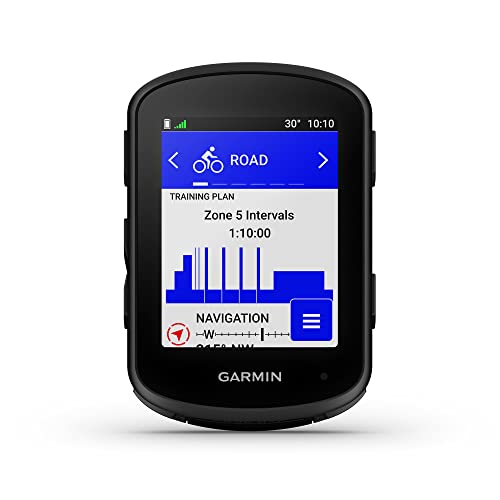
- Multi-band GNSS with touchscreen and button control
- ClimbPro and adaptive training guidance
- Up to 26 hours, or 32 in battery-saver mode
Best For: Serious training and demanding navigation
Best Premium Navigation Pick

- 2.8-inch color touchscreen with offline maps
- Turn prompts and app-connected rerouting
- Wi-Fi, ANT+/Bluetooth, and smart-trainer support
Best For: Cyclists who prioritize color navigation and connected training features
Best Value GPS Computer

- Up to 80 hours of riding-data storage
- ANT+ support for multiple cycling sensors
- 2.4-inch display with automatic backlight
Best For: Budget-conscious cyclists using external ANT+ sensors
Best Long-Battery Option

- Up to 40 hours of battery life
- More than 40 cycling data metrics
- Bluetooth and ANT+ sensor compatibility
Best For: Long-distance riders wanting broad data tracking and long battery life
Best Training Companion – Garmin Edge 540
The Garmin Edge 540 is a strong choice among bike computers with GPS for cyclists who want detailed navigation, training guidance, and performance data in a compact button-controlled design. Its multi-band GNSS supports enhanced positioning accuracy, while the 2.6-inch display keeps key information visible during rides.
Best For: Training-focused cyclists who want adaptive coaching, climbing data, and long battery life without a touchscreen.
Pros:
- Up to 26 hours of battery life in demanding use, or 42 hours in battery-saver mode.
- Multi-band GNSS helps provide enhanced positioning accuracy.
- Includes ClimbPro, suggested workouts, training prompts, and performance insights.
- Button controls can be practical in challenging riding conditions.
Cons:
- Advanced training features may require compatible power and heart-rate sensors.
- The 2.6-inch LCD is smaller than the display on premium touchscreen models.
The Edge 540 balances compact size with extensive training and navigation features. It is especially compelling for riders who prefer tactile controls and want to build structured training into everyday rides.
Best Long-Running Budget Pick – CYCPLUS G1 GPS Bike Computer
The CYCPLUS G1 is a straightforward option among bike computers with GPS, offering wireless route tracking, ride data, and a highly visible 2-inch backlit display. Its compact 70-gram design, IPX6 water resistance, and claimed battery life of more than 55 hours suit riders who want essential information with minimal complexity.
Best For: Everyday cyclists seeking a lightweight GPS computer with long battery life and basic ride metrics.
Pros:
- Tracks route, ride time, distance, mileage, clock, and altitude using GPS.
- More than 55 hours of stated working time from the 1200mAh battery.
- Automatic backlight and FSTN display are designed for visibility day or night.
- IPX6 water resistance and wireless operation reduce handlebar cable clutter.
Cons:
- Provides fewer advanced navigation and training features than premium models.
- The 2-inch screen is relatively small for map or data viewing.
The G1 focuses on the essentials rather than extensive connected features. Its long runtime, automatic backlight, and simple button interface make it a practical choice for routine rides and riders who value low-maintenance operation.
Best Premium Touchscreen – Garmin Edge 1050
The Garmin Edge 1050 is a premium entry in the bike computers with GPS category, pairing a vivid 3.5-inch touchscreen with advanced navigation, performance tracking, and connected riding features. It adds a built-in speaker, bike bell, road-hazard alerts, group-ride tools, and Garmin Pay to its extensive training functions.
Best For: Performance-oriented cyclists who want a large touchscreen, rich navigation, safety features, and connected ride tools.
Pros:
- Large 3.5-inch color touchscreen supports on-device course creation.
- Up to 20 hours of battery life in demanding use or 60 hours in battery-saver mode.
- Built-in speaker provides navigation prompts and a bike-bell function.
- Offers road-hazard alerts, group-ride messaging, incident alerts, and Garmin Pay when supported.
Cons:
- Its 5.7-ounce weight is higher than the compact Edge 540.
- Several connected features require a compatible smartphone, Garmin Connect, or compatible sensors.
- Premium features may be more than casual riders need.
The Edge 1050 is designed for riders who want a feature-rich command center rather than a basic cycling computer. Its large display and speaker improve usability, while its connected tools are particularly useful for group rides and longer adventures.
Best Route-Focused Option – Wahoo ELEMNT BOLT V3
The Wahoo ELEMNT BOLT V3 is a practical choice among bike computers with GPS for riders who prioritize turn-by-turn navigation and streamlined route syncing. It automatically downloads routes from compatible services, generates directions on demand, and uses screen prompts, LEDs, and audible cues to keep upcoming turns visible.
Best For: Route-oriented cyclists who want dependable turn prompts, simple account syncing, and radar compatibility.
Pros:
- Supports turn-by-turn prompts for GPX, TCX, and routes from services such as Strava, Komoot, and Ride With GPS.
- Can generate routes to destinations, addresses, or points of interest.
- Automatic uploads, smart notifications, and LiveTrack work with a compatible smartphone.
- ANT+ radar integration displays approaching vehicles and LED alerts.
Cons:
- Battery life is listed at up to 20 hours, shorter than some long-runtime competitors.
- Some route, notification, and LiveTrack functions require a smartphone or compatible accounts.
- The 2.3-inch display uses button controls rather than a touchscreen.
The BOLT V3 emphasizes efficient navigation and connected route management in a compact format. It is a good fit for riders who already use compatible cycling platforms and want automatic syncing without sacrificing on-device turn prompts.
Easy-Use Navigation Pick – Garmin Edge Explore 2
For riders who want bike computers with gps that are straightforward to operate, the Garmin Edge Explore 2 combines a glove- and rain-friendly 3-inch touchscreen with ready-to-use cycling profiles and route guidance. Its maps cover road, off-road, and indoor activities, while built-in GPS tracks essential ride data such as distance, speed, elevation, and location.
Best For: Recreational cyclists and e-bike riders who prioritize simple navigation and a large, sunlight-readable touchscreen.
Pros:
- Easy-to-use 3-inch touchscreen designed for glove and rain use
- Preloaded road, off-road, and indoor activity profiles simplify setup
- Ride-specific maps include popular roads, trails, searchable POIs, and e-bike routing
- Up to 16 hours of battery life, plus smartphone and Varia device compatibility
Cons:
- Heart-rate, speed, cadence, and Varia accessories are sold separately
- Its feature set is more navigation-focused than advanced training-focused
The Edge Explore 2 is a practical choice when easy navigation matters more than extensive performance analytics. E-bike integration and safety-device compatibility add useful flexibility for commuting, touring, and everyday rides.
Feature-Packed Value Pick – Magene C506 GPS Bike Computer
The Magene C506 is one of the more versatile bike computers with gps for riders who want navigation, indoor training, and broad sensor support in one compact unit. It pairs a 2.4-inch color touchscreen with Bluetooth, Wi-Fi, and ANT+ connectivity, and can download global maps, follow routes, and sync ride data through the OnelapFit app.
Best For: Connected cyclists and indoor-training users who want extensive data customization and long battery life.
Pros:
- Color touchscreen, three-button control, and lightweight 76-gram design
- Global map downloads, turn-by-turn navigation, and GPX route support
- Connects to nine device types, including sensors, smart trainers, radar lights, and electronic shifting systems
- Up to 24 hours in endurance mode with Wi-Fi and AGNSS support for positioning and syncing
Cons:
- Many training and analysis features depend on the OnelapFit app
- Its large number of settings and data options may feel overwhelming to casual riders
The C506 stands out for combining route navigation with indoor-training controls and extensive device compatibility. It is especially appealing if you already use smart trainers or multiple cycling sensors and want a customizable display.
Advanced Training Pick – Garmin Edge 840
The Garmin Edge 840 is designed for cyclists who want bike computers with gps to support both navigation and structured performance training. It offers touchscreen and button controls, multi-band GNSS for enhanced positioning, detailed cycling maps, and training tools such as ClimbPro, daily suggested workouts, power guidance, and stamina insights when paired with compatible sensors.
Best For: Serious cyclists and training-focused riders who need advanced navigation, climbing data, and adaptive workout guidance.
Pros:
- Multi-band GNSS supports enhanced positioning accuracy in challenging environments
- Touchscreen and button controls provide flexible operation while riding
- ClimbPro, daily suggested workouts, adaptive coaching, and power guidance support structured training
- Battery lasts up to 26 hours in demanding use or 32 hours in battery-saver mode
Cons:
- Several advanced training features require compatible power and heart-rate sensors
- Its extensive feature set may be more than casual riders need
The Edge 840 is the strongest fit here for riders who treat cycling as a structured training activity. Its combination of accurate positioning, climbing analysis, long battery life, and adaptive coaching makes it well suited to demanding rides and event preparation.
Best Premium Navigation Pick – GEOID CC700 Pro
For riders who want bike computers with gps plus built-in route guidance, the GEOID CC700 Pro combines a 2.8-inch color touchscreen with offline maps, turn prompts, and automatic rerouting. Wi-Fi syncing, ANT+/Bluetooth support, and indoor-training features make it a versatile choice for both outdoor navigation and structured workouts.
Best For: Cyclists who prioritize color navigation, route flexibility, and connected training features.
Pros:
- Color touchscreen with turn prompts, street names, zoom, and dual-perspective map views.
- Supports offline route downloads and reroutes when connected to the designated app.
- Works with GPS, BeiDou, GLONASS, QZSS, and Galileo for positioning.
- Supports smart-trainer workouts, FIT exports, Strava, and TrainingPeaks syncing.
Cons:
- Reroute planning requires connection to the designated app.
- The unit is more feature-rich than riders who only need basic ride tracking may require.
- DJI camera controls are limited to Action 4 and Action 5 Pro compatibility.
The CC700 Pro stands out when navigation is the priority. Its touchscreen maps and rerouting are useful for exploring unfamiliar roads, while Wi-Fi and indoor-training support add convenience for regular cyclists.
Best Value GPS Computer – COOSPO BC107
The COOSPO BC107 is a practical option among bike computers with gps for riders who want essential ride data without a touchscreen. Its 2.4-inch sunlight-readable display, auto backlight, ANT+ sensor support, and app-based Strava syncing cover the core needs of everyday cycling.
Best For: Budget-conscious cyclists who want long recording time and compatibility with external sensors.
Pros:
- Records up to 80 hours of riding data.
- ANT+ connectivity supports heart-rate, speed, cadence, and power sensors.
- Auto-backlit display is designed for visibility in changing conditions.
- CoospoRide app supports setup, route loading, firmware updates, and Strava syncing.
Cons:
- First-time GPS positioning can take 3–5 minutes and requires an outdoor location.
- The out-front mount is sold separately.
- Sensor bundles or additional sensors may be needed for expanded metrics.
The BC107 is a straightforward training companion with a strong battery advantage. It is best suited to riders who prefer button controls and plan to build their setup around ANT+ accessories rather than touchscreen mapping.
Best Long-Battery Option – iGPSPORT BSC100S
The iGPSPORT BSC100S offers a balanced feature set for riders comparing bike computers with gps. It provides coverage from five satellite systems, more than 40 ride metrics, a 2.6-inch anti-glare display, and up to 40 hours of battery life, while Bluetooth and ANT+ broaden sensor compatibility.
Best For: Long-distance riders who want broad data tracking, wireless sensor support, and dependable battery life.
Pros:
- Supports GPS, BeiDou, GLONASS, Galileo, and QZSS positioning.
- Tracks more than 40 metrics, including speed, distance, grade, cadence, calories, and temperature.
- Up to 40 hours of battery life with a USB-C charging port.
- Syncs with the iGPSPORT app and can share data to Strava and Komoot.
Cons:
- USB-C cable is not included.
- Uses button controls rather than a touchscreen.
- Route navigation or map-display features are not listed in the supplied specifications.
The BSC100S is a sensible middle ground for cyclists who want extensive ride data without paying for a navigation-focused touchscreen unit. Its long battery rating and dual-protocol connectivity are especially useful for extended rides.
How We Picked the Best Bike Computers with Gps
We focused on the features that matter most during real rides: GPS accuracy, screen readability, route guidance, battery capacity, weather resistance, wireless connectivity, and compatibility with sensors. We also considered how easy each computer is to configure, sync, read while moving, and use for different types of cycling.
The selection includes compact computers for everyday riders, navigation-focused models for touring and exploration, and advanced units for structured training, racing, and performance analysis. Product specifications can vary by bundle and region, so confirm the included mounts, sensors, maps, and accessories before ordering.
Quick Comparison
| Best For | What to Prioritize | Recommended Types |
|---|---|---|
| Basic ride tracking | Simple data screens, reliable GPS, long battery life | Compact monochrome or LCD computers |
| Turn-by-turn navigation | Color maps, rerouting, route import, readable display | Navigation-focused touchscreen models |
| Training and performance | ANT+, Bluetooth, structured workouts, advanced metrics | Garmin, Wahoo, and sensor-compatible units |
| Value and casual riding | Affordable price, waterproofing, straightforward setup | Entry-level wireless GPS computers |
Key Buying Factors for Bike Computers with Gps
Navigation and GPS Performance
For commuting and familiar routes, basic position tracking may be enough. Riders exploring unfamiliar roads should look for downloadable maps, turn-by-turn directions, rerouting, breadcrumb trails, and dependable route synchronization. GPS, Galileo, and other satellite support can improve tracking in challenging environments, but performance is also affected by trees, buildings, and terrain.
Display and Controls
Choose a screen size and control style that match your riding conditions. Physical buttons are useful in rain or when wearing gloves, while touchscreens can make maps and settings easier to manage. A high-contrast display and adjustable data fields are especially valuable in bright sunlight.
Battery, Durability, and Connectivity
Check the advertised runtime against your typical ride length, especially if you use navigation, sensors, or a bright backlight. Water resistance is important for unpredictable weather. ANT+ and Bluetooth support allow connection to heart-rate monitors, cadence sensors, power meters, smart trainers, and phones. Wi-Fi or automatic Bluetooth syncing can simplify uploads and firmware updates.
Training Features and Ecosystem
Serious cyclists may benefit from workout support, power data, recovery insights, climb information, and integration with services such as Strava or other training platforms. If you already own sensors or use a particular cycling app, compatibility with that ecosystem can matter more than a small difference in screen size.
Who Should Buy Which Bike Computers with Gps?
Choose a simple compact computer if you mainly want speed, distance, time, and dependable ride recording without a complicated interface. Select a navigation-oriented model if you regularly tour, travel, or ride unfamiliar roads. A touchscreen can be convenient for maps, while buttons may be preferable for wet-weather reliability.
Performance-focused road cyclists and serious enthusiasts should consider a computer with broad sensor support, structured training tools, and strong app integration. Mountain bikers and adventure riders should prioritize rugged construction, clear mapping, rerouting, and sufficient battery life. For occasional riders, commuters, and budget-conscious buyers, an affordable GPS unit with a readable screen and basic wireless connectivity usually provides the best value.