The best air-tire balance bikes give young riders a comfortable way to develop balance, steering, and confidence before moving to a pedal bike. Pneumatic tires can also provide a smoother ride across sidewalks, paths, and packed outdoor surfaces.
Our roundup includes lightweight toddler models, adjustable bikes for preschoolers, and larger options for older children. Use the guide below to compare fit, tire design, brakes, frame weight, and everyday practicality before choosing.
Best 10 Air Tire Balance Bikes Picks for 2026
Classic Air Ride Pick
Radio Flyer Air Ride Balance Bike

- 12-inch rubber air tires
- Tool-free adjustable seat
- Lightweight steel frame
Best For: Young riders ages 18 months to 5 years
Low-Maintenance Toddler Choice
SEREED Adjustable Balance Bike

- Flat-free EVA foam tires
- Tool-free seat and handlebar adjustment
- Lightweight 7.8-pound design
Best For: Beginner toddlers ages 2 to 3
Growing-Kid Trail Pick

- Real rubber air tires
- Wide seat and handlebar adjustment
- 110-pound frame capacity
Best For: Children ages 3 to 5 riding outdoors
Safety-Focused Air Tire Pick
Retrospec Cub Plus Balance Bike

- Adjustable child-sized V-brake
- Air-filled all-terrain tires
- Ultra-low step-through frame
Best For: Toddlers ages 18 months to 4 years
Adjustable Air-Tire Pick
- Inflatable rubber tires for grip and smoother riding
- Adjustable seat and handlebars for growing kids
- 8.5-pound frame supports up to 110 pounds
Best For: Growing children riding on mixed paved and unpaved terrain
Low-Maintenance Starter
ZIFFY JOVA 12-Inch Balance Bike

- Puncture-proof foam-rubber tires need no air
- Footrests encourage balance-building gliding
- Designed for children ages 2–5
Best For: Young beginners and parents who prefer maintenance-free tires
Lightweight Air-Tire Choice

- Inflatable tires add traction and shock absorption
- 8.6-pound composite frame is easy to carry
- Adjustable seat and two-year warranty included
Best For: Ages 3–6 riding on grass, pavement, and gravel
Lightweight Starter Pick

- 6.4-pound frame is easy for toddlers to handle
- Inflatable tires suit indoor and outdoor surfaces
- Seat adjusts from 13 to 17.3 inches
Best For: Younger beginners ages 2–5
All-Terrain Growth Pick

- Deep-tread air tires target grass, gravel, and pavement
- Adjustable seat and padded saddle support growth
- 8.16-pound frame has a 110-pound stated capacity
Best For: Outdoor-focused riders ages 3–6
Classic Air Ride Pick – Radio Flyer Air Ride Balance Bike
The Radio Flyer Air Ride is a straightforward choice for families looking for air tire balance bikes with a smooth ride across sidewalks, grass, and gravel. Its 12-inch rubber tires, adjustable seat, and lightweight steel frame suit young riders developing balance and steering skills.
Best For: Toddlers and young children ages 18 months to 5 years who need a classic, adaptable outdoor balance bike.
Pros:
- 12-inch rubber air tires provide a smooth ride across several surfaces.
- Tool-free adjustable seat accommodates growing children.
- Grip tape creates a no-slip foot area while gliding.
- Lightweight 7.9-pound frame is easy for children to handle.
Cons:
- Air-filled tires may require inflation and maintenance.
- Rigid suspension and coaster brake offer a relatively simple setup.
Choose this model if you value traditional styling, pneumatic tires, and an easy-to-adjust seat. It is a practical fit for families wanting one balance bike to cover several early riding years.
Low-Maintenance Toddler Choice – SEREED Adjustable Balance Bike
The SEREED is a useful alternative for shoppers comparing air tire balance bikes but preferring tires that never go flat. Its EVA foam tires are quiet, anti-slip, and suitable for indoor or outdoor gliding, while the adjustable seat and handlebars help accommodate growth.
Best For: Beginner riders ages 2 to 3 and families seeking a portable, low-maintenance balance bike.
Pros:
- Airless EVA tires cannot go flat and are designed to avoid floor scratches.
- Quick-release adjustments require no tools.
- Footrest, rubber grips, and soft saddle support comfortable riding.
- 7.8-pound design and trunk-friendly portability suit family outings.
Cons:
- Foam tires do not provide the same pneumatic feel as real air tires.
- No brakes are included.
- Its listed wheel size is smaller than some competing models.
This bike stands out when convenience matters more than true pneumatic tires. The flat-free wheels and broad adjustment range make it a sensible starter for indoor practice and paved outdoor paths.
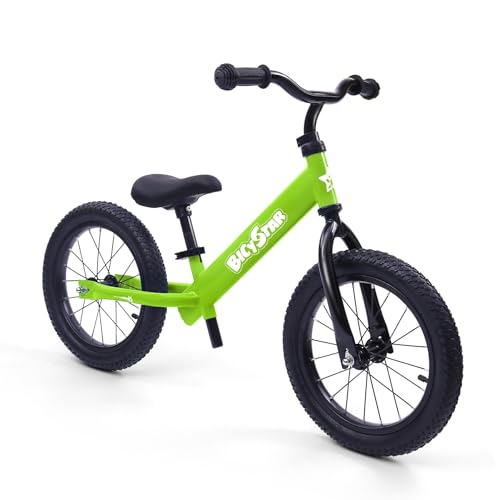
Growing-Kid Trail Pick – bicystar 14-Inch Balance Bike
The bicystar 14-inch model is aimed at older preschool riders who want real rubber air tires for grip on gravel and smooth indoor rolling. Its broad seat and handlebar adjustment range, footrest, and 110-pound weight recommendation make it a substantial option among air tire balance bikes.
Best For: Children ages 3 to 5 who need a larger balance bike for outdoor trails and continued growth.
Pros:
- Inflatable rubber tires provide outdoor grip and smooth rolling.
- Seat and handlebars adjust across a wide range.
- Carbon steel frame supports up to 110 pounds.
- Includes tools and extended frame, tire, and parts warranty coverage.
Cons:
- At 8.5 pounds, it is heavier than some toddler-focused models.
- Air tires require inflation and upkeep.
- The 14-inch size may be too large for younger or smaller beginners.
Consider this model when your child is ready for a larger frame and you expect to ride beyond smooth pavement. Its adjustable fit and real air tires give it a strong emphasis on outdoor confidence-building.
Safety-Focused Air Tire Pick – Retrospec Cub Plus Balance Bike
The Retrospec Cub Plus combines air-filled tires with a child-sized adjustable V-brake, making it a notable option for parents comparing air tire balance bikes with added stopping control. Its low frame and adjustable cockpit are designed to help toddlers mount easily and learn riding fundamentals.
Best For: Toddlers ages 18 months to 4 years who need air-filled wheels and a learning-friendly brake.
Pros:
- Air-filled tires provide smooth riding across outdoor terrain and unpaved trails.
- Adjustable V-brake teaches early stopping techniques.
- Ultra-low frame makes mounting and dismounting easier.
- Adjustable seat and handlebars support growing riders.
Cons:
- At 9 pounds, it is heavier than some lightweight balance bikes.
- Its 50-pound maximum weight recommendation is lower than some alternatives.
- Air-filled wheels require occasional inflation.
This is a strong fit if braking instruction and easy mounting are priorities. The low frame supports confidence for beginners, while the pneumatic tires help keep rides comfortable on varied outdoor surfaces.
Adjustable Air-Tire Pick – bicystar 16-Inch Balance Bike
For families comparing air tire balance bikes, the bicystar stands out with inflatable rubber tires, generous adjustability, and a sturdy carbon-steel frame. Its 8.5-pound design is manageable for young riders and convenient for parents to carry.
Best For: Kids roughly 5–8 years old who need an adjustable bike for paved roads, gravel, and urban riding.
Pros:
- Inflatable rubber tires provide outdoor grip and a smoother ride indoors.
- Seat and handlebar heights adjust to accommodate growing children.
- Wide carbon-steel frame supports up to 110 pounds.
- Includes a coasting footrest, padded seat, and extensive frame and parts warranty coverage.
Cons:
- Air tires require inflation and may need occasional maintenance.
- Its 14-inch wheel size and listed fit range may not suit smaller toddlers.
The bicystar is a practical choice when adjustability, real tire traction, and long-term support matter more than the simplest maintenance. It is especially appealing for children ready to build balance before moving to a pedal bike.
Low-Maintenance Starter – ZIFFY JOVA 12-Inch Balance Bike
The ZIFFY JOVA is a lightweight entry-level option for younger children, but it is not an air tire balance bike. Instead, its puncture-proof foam-rubber tires eliminate inflation and offer dependable rides across common indoor and outdoor surfaces.
Best For: Toddlers ages 2–5 who need a low-maintenance first balance bike for parks, grass, gravel, and indoor floors.
Pros:
- Puncture-proof foam-rubber tires require no air or inflation upkeep.
- Built-in footrests help children practice gliding with their feet raised.
- Soft grips and a cushioned PU seat support comfortable riding.
- Carbon-steel frame supports up to 110 pounds.
Cons:
- Foam tires do not provide the same air-tire ride characteristics requested for this category.
- No warranty is listed in the supplied details.
- The bike is intended for younger riders and has limited fit adjustability information.
If avoiding flat tires and routine inflation is your priority, the ZIFFY JOVA is a straightforward starter. Buyers specifically seeking inflatable traction should consider one of the other options instead.
Lightweight Air-Tire Choice – Ridego 14-Inch Balance Bike
The Ridego is a strong contender among air tire balance bikes, pairing inflatable rubber tires with shock absorption and traction for grass, pavement, and gravel. Its fiber-reinforced composite frame weighs 8.6 pounds while remaining impact-resistant and rust-resistant.
Best For: Kids ages 3–6 who need a lightweight balance bike for mixed-terrain outdoor play.
Pros:
- Inflatable rubber tires provide traction, quiet operation, and shock absorption.
- Adjustable seat accommodates growing riders from about 3 to 6 years old.
- Lightweight composite frame is easy for children to lift and parents to carry.
- Two-year manufacturer warranty is included.
Cons:
- There is no brake listed in the supplied specifications.
- The seat adjustment range is narrower than some larger balance bikes.
- Air tires require inflation and occasional pressure checks.
Ridego balances real-tire performance with a light, durable frame. It is a sensible pick for younger children who will ride across varied surfaces and benefit from a bike that is easier to carry.
Lightweight Starter Pick – Birtech 12-Inch Balance Bike
If you are comparing air tire balance bikes for a younger toddler, the Birtech 12-inch model combines inflatable rubber tires with a particularly light 6.4-pound frame. Its adjustable seat and partially pre-installed design make it practical for first rides indoors or outdoors.
Best For: Toddlers ages 2–5 with an 11–16-inch inseam who need a lightweight beginner bike.
Pros:
- Inflatable 12-inch rubber tires provide shock absorption and traction on concrete, grass, playgrounds, and indoor flooring.
- Seat adjusts from 13 to 17.3 inches with a no-tool quick-release clamp.
- Lightweight nylon-fiberglass frame weighs just 6.4 pounds and has a stated 70-pound maximum recommendation.
- U-shaped footrest, non-slip grips, and a 360-degree-rotating handlebar support beginner control.
Cons:
- There are no brakes, so stopping depends on the rider’s feet.
- The 12-inch wheel size may be outgrown sooner than a larger 14-inch option.
Choose this Birtech if low weight, a wide fit range for younger riders, and easy seat adjustment matter most. It is a straightforward training bike rather than a model with braking or drivetrain features.
Quiet Mixed-Terrain Choice – Ridego 14-Inch Air-Tire Balance Bike
For families seeking air tire balance bikes for children who ride on pavement, grass, or gravel, this Ridego pairs 14-inch inflatable rubber tires with a lightweight glass-reinforced nylon frame. The larger wheels and adjustable saddle are suited to growing riders ages 3–6.
Best For: Kids ages 3–6 who want a stable, quiet ride across common outdoor surfaces.
Pros:
- Inflatable tires provide shock absorption, traction, and a quieter ride on grass, pavement, and gravel.
- 14.2–18.3-inch adjustable seat accommodates growth.
- Glass-reinforced nylon frame weighs 8.6 pounds while remaining impact-proof and rust-resistant according to the supplied specifications.
- Non-slip grips and a soft, wide saddle support comfort and control.
Cons:
- No brakes are listed, so children must learn to stop with their feet.
- Its stated intended terrain is paved roads, despite the tires also being described for grass and gravel.
This model is a sensible middle-ground option for a child who has outgrown a smaller balance bike but still needs a simple, pedal-free setup. The 14-inch wheels and air tires favor comfort over minimum weight.
All-Terrain Growth Pick – Ridego 14-Inch Balance Bike
This Ridego is one of the more adventure-oriented air tire balance bikes in the group, with deep-tread inflatable rubber tires designed for grass, gravel, and pavement. It also adds a footrest, padded saddle, and an adjustable seat for children ages 3–6.
Best For: Growing children who need a durable 14-inch bike for sidewalks, backyards, and unpaved trails.
Pros:
- Air-filled tires with deep anti-slip tread are designed for shock absorption and grip on multiple surfaces.
- Seat adjusts from 14.2 to 18.3 inches and includes a soft padded saddle.
- Glass-reinforced nylon frame weighs 8.16 pounds and has a stated 110-pound maximum weight recommendation.
- Footrest and non-slip handlebars add comfort and control during rides.
Cons:
- The supplied details list a coaster brake, but the bike is also described as having no pedals, so buyers should confirm the exact stopping setup.
- At 8.16 pounds, it is heavier than the Birtech 12-inch model.
Consider this Ridego when terrain versatility and a generous stated weight capacity are priorities. Its larger wheels and comfort features make it well suited to longer outdoor practice sessions as children develop steering and balance.
How We Picked the Best Air Tire Balance Bikes
We focused on the features that matter most for early riders: age and height range, seat adjustability, frame weight, tire type, steering control, braking equipment, and expected riding surfaces. Air-filled rubber tires were prioritized for their cushioning and traction, while lightweight frames were favored because children can push, turn, and recover more easily when a bike is manageable.
We also included a range of wheel sizes and designs for toddlers through early elementary-age riders. Because manufacturer age ranges can overlap or vary, parents should confirm the child’s inseam and check that both feet can rest comfortably on the ground.
Quick Comparison
| Best For | What to Look For |
|---|---|
| Young toddlers | Low step-through frame, very low seat, light overall weight |
| Preschool riders | Adjustable seat, 12- or 14-inch wheels, stable pneumatic tires |
| Taller or older children | 16-inch wheels, higher seat range, longer-lasting frame fit |
| Mixed surfaces | Inflatable rubber tires with useful tread and dependable valves |
| Parents prioritizing control | Handlebar limiters, comfortable grips, and an accessible hand brake |
Key Buying Factors for Air-Tire Balance Bikes
Fit and Seat Height
Fit is more important than the stated age range. A child should be able to sit naturally with slightly bent knees and place both feet flat on the ground. An adjustable seat helps the bike grow with the rider, but the lowest available setting must still suit the child today.
Air Tires and Maintenance
Air tires generally absorb bumps better than solid foam tires and can offer improved traction. They do require occasional pressure checks, and punctures are possible. Look for standard valve access, durable tread, and replacement-tube availability when possible.
Weight, Brakes, and Safety
A balance bike should be light enough for the child to control without adult help. A hand brake can be useful for older or faster riders, but younger children may initially rely on their feet. Regardless of equipment, use a properly fitted helmet and supervise practice in a traffic-free area.
Who Should Buy Which Air Tire Balance Bikes?
Choose a compact 12-inch model for a smaller toddler or a child beginning around age two. A 14-inch air-tire balance bike is a versatile choice for many preschoolers and offers more room to grow. Consider a 16-inch model for taller children or riders who have already outgrown smaller frames. If portability matters, prioritize the lightest suitable option; if comfort on uneven paths matters most, favor pneumatic tires and a sturdy adjustable frame.